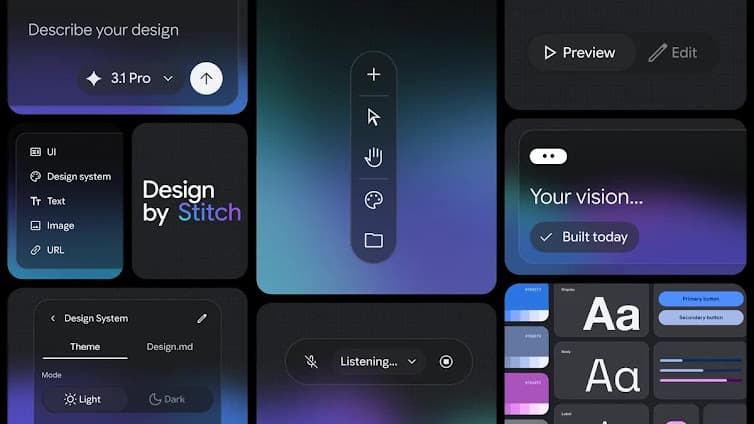

We are standing at the precipice of a fundamental shift in how we build digital interfaces. The traditional gap between a designer’s vision and a working mockup is closing rapidly, and at the forefront of this revolution is Google’s Stitch AI.
✨ The Evolution of UI Prototyping
For years, the UI/UX design process has been a labor-intensive cycle: sketch, wireframe, high-fidelity mockup, handoff, and finally, code. While tools like Figma revolutionized collaboration, the translation from idea to interface still required hours of pixel-pushing. Stitch AI by Google is changing that paradigm entirely by introducing true generative AI into the design system workflow.
🤖 What is Google Stitch AI?
Stitch AI is not just another image generator; it is a specialized, context-aware AI designed specifically for user interfaces. Instead of generating flat, unusable raster images, Stitch understands the fundamental building blocks of web and mobile apps—components, layouts, typography, and design tokens.
By leveraging advanced natural language processing and vast datasets of UI patterns, Stitch allows designers and developers to generate functional screen layouts and component variants simply by describing what they need.
⚡ How Stitch AI Transforms the Workflow
The integration of Stitch AI into the design pipeline brings several massive advantages to modern product teams:
- ✅ Text-to-Screen Generation: Need a dark-mode analytics dashboard with a sidebar and a line chart? Describe it, and Stitch generates the layout instantly, adhering to best practices.
- ✅ Design System Adherence: Unlike generic AI art generators, Stitch respects your foundational design tokens (colors, fonts, shapes). When it generates a screen, it looks like your brand, not a generic template.
- ✅ Rapid Iteration & Variants: Generating multiple A/B test variants or exploring different layout strategies now takes seconds instead of hours.
"AI won't replace designers; but designers who use AI will replace those who don't. Stitch AI acts as an infinitely fast junior designer, freeing us up to focus on user psychology and complex problem-solving."
🌉 Bridging the Developer-Designer Gap
One of the most notorious friction points in software development is the "handoff." Because Stitch AI operates fundamentally on component-based logic rather than flat pixels, the generated mockups are inherently closer to code. This shared language drastically reduces misinterpretations and allows front-end engineers to build faster, using pre-approved design systems.
🚀 The Future of Creativity
As we move further into this new era, the role of the UI/UX designer will shift from "pixel manipulator" to "system architect and curator." With tools like Google's Stitch AI handling the tedious generation of standard layouts, we will have more time to focus on what truly matters: creating delightful, deeply human, and highly accessible user experiences.
The future of design isn't about working harder; it's about thinking bigger.