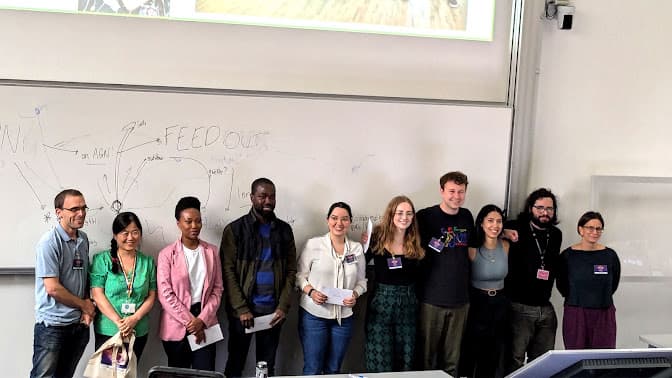

I recently had the incredible opportunity to attend the "AGN Populations Across Continents & Cosmic Time" conference, hosted jointly by Durham University and Newcastle University in the United Kingdom 🏴. This was undoubtedly one of the most memorable and well-organized conferences I have ever attended, filled with inspiring discussions and brilliant minds from across the globe.
✨ What exactly is an AGN?

For those outside the field of astrophysics, an AGN (Active Galactic Nucleus) is the extraordinarily bright and energetic center of a galaxy. This extreme luminosity is powered by a supermassive black hole (SMBH) actively consuming surrounding gas and matter. As this material spirals into the black hole, it heats up and releases vast amounts of radiation across the electromagnetic spectrum, sometimes outshining its entire host galaxy. They are some of the most fascinating phenomena in the universe! 🚀🔭
🌍 Fostering True Equity & Cross-Continental Collaboration

What set this conference apart from typical academic symposia was its profound commitment to representation. Nearly 45% of all attendees were astronomers representing African institutions.
In many parts of the global south, researchers face significant funding constraints, making travel to European scientific conferences prohibitively expensive. To dismantle these barriers, the organizers successfully raised dedicated resources to cover travel, lodging, and logistics for African delegates. For many, this was their first-ever opportunity to present their research at an international venue, creating a genuinely supportive and collaborative environment across continents.
🙋♀️ Spotlight on Leadership: Dr. Leah Morabito's Advocacy
A significant driving force behind this conference's dual mission of rigorous science and social progress was its co-chair, Dr. Leah Morabito. Dr. Morabito, a UKRI Future Leaders Fellow in Astrophysics at Durham University, is a passionate advocate for gender and racial equality in physics.
Her outstanding contributions include:
- 📊 Departmental Impact: Serves on the Departmental Equality, Diversity, and Inclusion (EDI) Committee at Durham University, steering workplace surveys to identify concrete areas for improvement.
- 🪐 Global Mentorship: Mentoring through the Supernova Foundation, providing vital career guidance and networking for women and gender minorities in Physics across the globe.
- ✊ Co-chairing with a Purpose: Transformed talk into dynamic action by co-leading the effort to fully fund African scientists, building structural equity in the global research pipeline.
You can explore her extensive resource collections and recommended advocacy reading lists on her Advocacy Portal.
🔭 Key Highlights & Discoveries
The conference covered a massive amount of ground regarding the current state of astrophysics. Some of the most impactful discussions included:
Black Hole Growth
Exploring how supermassive black holes grow and evolve across cosmic time and scale.
Multi-Wavelength Surveys
How observing the universe across different light spectrums is drastically shifting our AGN models.
Galactic Influence
The complex feedback loops between AGN and host galaxies, influencing one another's co-evolution.
The Future of Data
An exciting look at cutting-edge tools, ML pipelines, and algorithms being built for future cosmic datasets.
"I am incredibly grateful for the invaluable learning and networking opportunities this week provided. More than just the science, it was a profound chance to promote astronomy and collaborate with highly sociable, inspiring people."
🚀 Let's Promote Astronomy For the Next Gen! 🌠
📚 References & Further Reading
Explore the official releases, academic files, and community posts relative to the event:
- Social Feed 🔗 LinkedIn Post: View my original reflections and network updates in my original post on LinkedIn.
- Scientific Report 📝 Official Conference Report: Read the formal outcomes of the event in the conference report published on arXiv (arXiv:2411.12834).
- University News 📰 Newcastle University Feature: Read the success profile via the Newcastle School of Mathematics, Statistics and Physics News.
- Advocacy Hub 🎓 Co-Chair Advocacy Portfolio: Learn more about Dr. Leah Morabito's equity and diversity initiatives at Dr. Leah Morabito - Welcome & Advocacy.
- Web Portal 🌐 Conference Homepage: Visit the Official AGN Across Continents Website